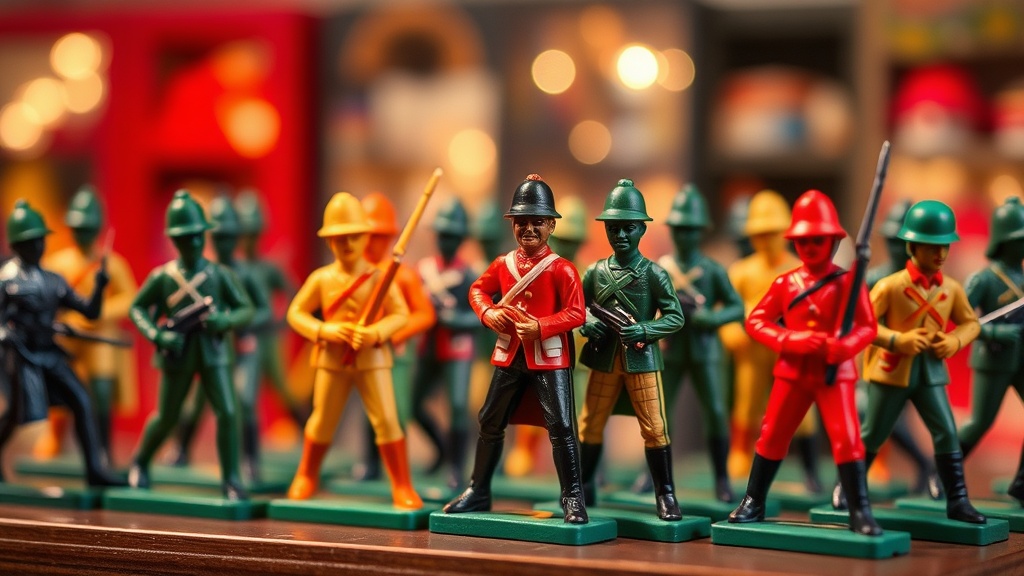
Which Classic Toy Soldier Brands Still Hold Their Value Today?

Why Do Some Toy Soldiers Appreciate While Others Collect Dust?
You've probably stared at a flea market bin of old plastic soldiers wondering—which ones are actually worth bringing home? The toy soldier market is strange. Some pieces that sold for pocket change decades ago now command serious money at auction, while others that seemed like safe bets have barely kept pace with inflation. This isn't about getting rich quick (collecting rarely works that way), but about understanding what separates the forgotten brands from the ones that still matter. Whether you're hunting for your first vintage piece or thinning out a crowded collection, knowing which manufacturers built lasting value helps you spend smarter—and appreciate what you've got.
What Made Britain's the Gold Standard for So Long?
Britain's—the name alone carries weight in collecting circles. William Britain started casting hollow-cast lead soldiers in 1893, and for nearly a century, his company defined what a "proper" toy soldier looked like. The firm's heyday stretched from the 1920s through the 1950s, when their detailed paintwork and historically accurate uniforms set them apart from cheaper competitors.
Here's what collectors chase today: pre-1966 hollow-cast figures (before safety regulations forced a shift to plastic), the Deetail line from the 1970s (a clever compromise—metal bodies with plastic bases), and limited production runs commissioned by British department stores. A single Britain's Life Guard in pristine condition can fetch $200-400. Boxed sets? Multiply that.
The value proposition is straightforward—Britain's documented everything. Factory catalogs, production numbers, paint variants. This obsessiveness created a collecting infrastructure that still supports the market. There's a book for every sub-collection, a specialist dealer for every obscure regiment. That research ecosystem keeps prices transparent and demand steady.
But Britain's also illustrates a harsh truth: not everything old is valuable. Their 1980s and 1990s output—much of it plastic, much of it aimed at the souvenir market rather than serious collectors—trades at a fraction of vintage prices. The brand survived, but the magic dimmed. Smart buyers learn to distinguish between "old Britain's" and "Britain's that's merely old."
How Did Timpo Capture the Imagination of a Generation?
If Britain's was the aristocrat, Timpo was the populist. Founded in 1938 by Salomon "Sally" Gawrylovitz, Timpo Toys produced millions of plastic soldiers from their London factory. Their figures weren't as refined as Britain's best work—paint was simpler, poses more limited—but they were affordable, durable, and weirdly charismatic.
Timpo's value story is different. While top-tier Britain's pieces have always been expensive, Timpo appreciation happened gradually. Collectors who grew up with these figures in the 1950s and 60s reached peak earning power in the 1990s and 2000s—and started buying back their childhoods. Prices climbed steadily, especially for complete boxed sets and rare color variations.
The "swap-able" system was Timpo's genius. Their cowboy and Indian sets featured figures with separate heads, torsos, and legs that clicked together. Kids mixed and matched; collectors now hunt specific combinations. A "Mexican Bandit" head on a "Cowboy" body isn't a mistake—it's a documented factory variant worth tracking down.
Timpo's 1978 bankruptcy adds scarcity to the equation. Unlike Britain's, which limped along for decades, Timpo disappeared abruptly. There's no modern reissue muddling the market, no corporate owner cranking out "anniversary editions." What exists is what survived—and plenty got destroyed by the rough play these toys were built for.
Why Are Contemporary Makers Like King & Country Commanding Premium Prices?
The modern market has its own hierarchy, and Hong Kong-based King & Country sits near the top. Founded in 1984 by Andy Nielsen and Laura Johnson, the company took a radically different approach: limited production runs, meticulous hand-painting, and prices that started high and kept climbing.
A single King & Country figure might cost $80-150 new. Complete boxed sets—like their sprawling World War I trench diorama pieces—can run into the thousands. This isn't mass-market collecting; it's more adjacent to the fine art market than to the toy aisle.
The value proposition here is different. These pieces don't appreciate because of nostalgia—they appreciate because of scarcity and craftsmanship. Production numbers are genuinely limited. When a mold wears out, it gets retired. Collectors who bought King & Country's early 1990s releases have seen significant returns, not because of market manipulation, but because the supply was always constrained.
Contemporary makers like John Jenkins Designs and Thomas Gunn operate similarly—small batches, high prices, collector-focused distribution. The risk is different here. You're betting on continued collector interest in high-end miniatures, not on rediscovery of a forgotten childhood favorite. So far, that bet has paid off for many—but the market is thinner, less liquid than vintage pieces.
Which Forgotten Brands Might Be Undervalued Right Now?
Here's where it gets interesting. While everyone chases Britain's and debates King & Country's latest release, some lesser-known manufacturers sit quietly in the overlooked middle.
Marx—Louis Marx's American factory produced billions of plastic figures between 1955 and 1978. Their 54mm "Warriors of the World" sets were ubiquitous in American toy boxes. Prices have risen, but slowly. The sheer quantity produced keeps values reasonable, which means collectors can still build impressive armies without emptying their savings. Marx's complex factory history (multiple plants, countless contract variations) also creates niches for specialists who enjoy research as much as acquisition.
Airfix—Better known for model kits, Airfix's 1:32 scale soldier sets from the late 1970s are sleeper hits. The quality varied wildly—some figures were crude, others surprisingly detailed—but the range covered conflicts (Zulu Wars, Foreign Legion, Japanese Infantry) that bigger brands ignored. Mint-boxed sets have doubled in value over the past decade.
Charbens and Crescent—These smaller British manufacturers operated in Britain's shadow, producing hollow-cast figures that were often more colorful and less historically rigid. Their Cowboys and Indians sets are particularly sought after. Because they produced fewer total figures, complete sets in good condition are genuinely scarce—not artificially scarce, but actually hard to find.
Starlux—The French manufacturer occupies a unique position. Their figures have a distinct style—more stylized than British or American competitors, with expressive poses and bold paint schemes. The French collecting market is less connected to the English-speaking world, which means prices often lag. For collectors willing to navigate language barriers and shipping complications, Starlux represents genuine value.
How Should You Actually Buy Based on Brand History?
The practical takeaway: brand matters, but condition and completeness matter more. A battered Britain's figure missing its rifle isn't automatically more valuable than a pristine Timpo in its original box. Documentation—catalogs, dealer price lists, factory records—adds provenance that serious buyers will pay for.
For new collectors, I'd suggest starting with Timpo or Marx. Both offer enough variety to keep hunting interesting, enough documentation to learn from, and enough availability that you can actually find pieces without hiring a specialist dealer. Build knowledge before chasing the high-end stuff.
For experienced collectors looking at appreciation potential, watch the contemporary makers. King & Country's early releases (1984-1995) are already climbing, but their newer "Collector Club" exclusives might follow the same trajectory. The risk is higher, but so is the quality—and the enjoyment of owning something genuinely scarce.
The forgotten brands—Charbens, Crescent, Starlux—reward patience. These aren't markets where you flip pieces quickly. They're markets where you buy well, hold for years, and eventually find the one collector who needs exactly what you've got. That collector usually pays generously.
One final thought: the brands that hold value tend to be the brands that told stories. Britain's recreated historical battles. Timpo let children stage their own Westerns. King & Country builds dioramas that transport viewers to specific moments. A toy soldier without a narrative context is just painted metal or plastic. The brands that understood this—the ones that gave collectors worlds to imagine—are the ones still worth collecting.